20th July, 2022 – Market Morning Brief
| Global Market Indices | As at July 18 | As at July 19 | Change | % Change |
| Dow Jones Industrials | 31,072.61 | 31,827.05 | +754.44 | +2.43% |
| S&P 500 | 3,830.85 | 3,936.69 | +105.84 | +2.76% |
| Nasdaq Composite | 14,403.18 | 14,766.60 | +363.42 | +2.52% |
| FTSE 100 | 7,223.24 | 7,296.28 | +73.04 | +1.01% |
| DAX Performance Index | 12,959.81 | 13,308.41 | +348.60 | +2.69% |
| STOXX Europe 600 | 3,511.86 | 3,587.44 | +75.58 | +2.15% |
| SSE Composite index | 3,278.10 | 3,279.43 | +1.33 | +0.04% |
| SZSE Component Index | 12,532.65 | 12,494.77 | -37.88 | -0.30% |
| Hang Seng Index | 20,846.18 | 20,661.06 | -185.12 | -0.89% |
| Nikkei 225 | 26788.47 | 26,961.68 | +173.21 | +0.65% |
| KLCI | 1,429.54 | 1,428.76 | -0.78 | -0.05% |
| STI | 3121.76 | 3,117.79 | -3.97 | -0.13% |
| JKSE – | 6,659.25 | 6,736.09 | +76.84 | +1.15% |
Global Market Indices – Our Opinions
A trend of an Interest rate hikes across major economies are imminent as Central Banks around the world are looking at a tightening of monetary policy . The abnormal jump across the stock market (what is jumping across the stock market?) is seen today despite the looming certainty of an increase in interest rate. Agents(?) in the economy may have adjusted their inflation expectations for the future thus deciding to spend today rather than tomorrow (? Do your mean that “The recent surge in consumer spending in recent period could be short-lived as consumers purchase essential food stuff and other essential ahead of further rise in prices). We expect this positive performance to be short-lived just before the Central Banks announce the official increase in interest rate (This does not quite make sense. If interest rates are expected to rise in the immediate future, there is very little incentive to spend more now as they would have to pay higher interest shortly).
A The threat of recession continues to loom in over the economy despite (it is ‘because of’ and not ‘despite’) global efforts to combat inflation as the uncertainty lies with the Nord 1 gas steam on its serviceability (the main inflationary pressure is coming from supply shortage and not uncertainty; that is, the inflationary was already in place before the Ukraine war and the supply chain problem as a result of over printing of money.).
US Market Indices – A strong rebound built on positive investors’ sentiment
Notwithstanding the inflation threat, the US Market has confirmed a rebounded on after Tuesday’s closing on Market Indices on with DJI, S&P and NASDAQ to improve by rising 2.43%, 2.76%, 2.52% respectively. Both S&P 500 and Nasdaq closed above their 50-days averages on Tuesday. This stock rally is spurred by a dip in the dollar as well as speculation that the worst of 2022’s equity rout is over. Dollar has shed about 1% this week, underscoring waning haven? demand for the greenback and the brighter mood in markets (what do you mean by ‘brighter mood in market’ of greenback?).
Treasuries held a declined that took lifting the 10-year yield back above 3%, to 3.026% on 19 July. This rising yield indicates falling demand for Treasury bonds, showing that investors about the economy are looking to shift to higher-risk, higher-reward investments (The structure of your idea is off; the higher long-term yield reflects greater uncertainty of the future and hence, investors are expecting greater risk premium) . This is likely due to several blue chip stocks reporting better than expected earnings which restored investor’s confidence, such as Netflix (You have to revise the this sentence with the one before as you are treading on contradictory conclusions). The speculation on company earnings will hold up (no idea what you are saying) and that the Federal Reserve will avoid aggressive monetary tightening appears to be giving investors some comfort. At least in the immediate period. This will however be required to be confirmed again during It is only in the FOMC Meeting next week on 26-27 July will we know the extent of hawkiness of the Fed.
European Market Indices – A strong rebound built on positive investors’ sentiment
The European market has rebounded following the rally in the US market which was mainly based on the positive investment sentiments on the earnings report published on 19 July. These effects spilled from the US market into the European and Asian Market. European market indices such as DAX and STOXX600 have improved by 2.69% and 2.15% respectively. After Tuesday’s The Euro was at a 2-week high against the dollar on the possibility of a bigger than expected European Central Bank interest rate hike Thursday.
EUROPEAN shares hit more than a five-week high on Tuesday after a report that Russian gas flows to Europe via the Nord Stream 1 pipeline are seen restarting on time allayed some concerns about an energy supply crunch on the continent. Gains were broad-based on Tuesday, with the automobile sector leading the pack with a 3.1 per cent jump, followed by a 2.9 per cent rise in banks.
“The energy crisis is one of the biggest worries for Europe’s investors and citizens…. Having a stable source of energy as opposed to an unstable source is certainly a meaningful piece of news,” said Steve Sosnick, chief strategist at Interactive Brokers.
The pan-European Stoxx 600 index closed 1.4 per cent up at its highest level since June 10, logging its third consecutive day of gains. It fell as much as 0.7 per cent earlier in the session on worries about a hawkish European Central Bank and slowing economic growth.
Sources told Reuters ECB policymakers are considering raising interest rates by a bigger-than-expected 50 basis points at their meeting on Thursday to tame record-high inflation.
ECB Interest Hike
The prospect of a policy tightening could come as a relief to euro investors. The ECB is trailing the Federal Reserve in raising borrowing costs as it attempts to tackle inflation, a divergence that knocked the euro currency to below parity with the dollar. The European economy faces a potential shutoff of gas supplies from Russia, which could drag the region into a recession. The ECB’s plan to prevent borrowing costs from blowing out in peripheral nations could also fall short of investor expectations. Allowing the currency fall worsens inflation, but the opposite approach could hit growth and a potential rebound.
Opinion: The Europeans’ effort to combat inflation through an increase in interest rate weighs bigger interest rate hike with safety nets for indebted countries. Many of the uncertainties lie on Thursday where the maintenance for Nord 1 Stream will finish its maintenance and gas supply should resume as Putin said that Gazprom will fulfill its obligations.
(I have actually edited the two major topics above but forgot to save the comments. Please see me on issues relating these write-ups.)
Middle-East
Biden-Salman (What kind of headline is this? It comes off rather silly.)
The encounter between the two leaders was considered a fraught moment for many democrats because of Salman’s chummy ties with Trump and his dismal human-rights record. Biden refused to talk to the Saudi prince since he took office, for weeks the president insisted he was not going to Jeddah to meet the prince.
Instead, he would attend a meeting with leaders of six Gulf countries making the trip a controversial one. It would have been less controversial if Biden made any meanigful progress with Salman but it didn’t. With the Israeli officials playing down the talk of a breakthrough between US-Saudi with Saudi not in a rush to make any deals with the US.
Biden is expected to allow more airlines to fly over the Saudi airspace. On oil, even if the Saudis agree to pump more, it is unclear how long they can run fields at full, and whether the world has enough refining capacity to turn extra crude into fuel.
The trip fell short with no real progress but some friendly gestures between the parties. Biden was being blasted by some for even traveling to oil-rich Saudi Arabia, much less visiting with the man suspected of responsibility for the assassination (of who?).
(There is not much issue about the sentence constructions and the message being conveyed. The main problem is that this topic did not focus on the most fundamental reason why President Biden wants to meet up with Prince Salman and his failure in achieving the objective and hence the economic and political implications going forward.)
Russian-Iran Relations (this headline has no meaning)
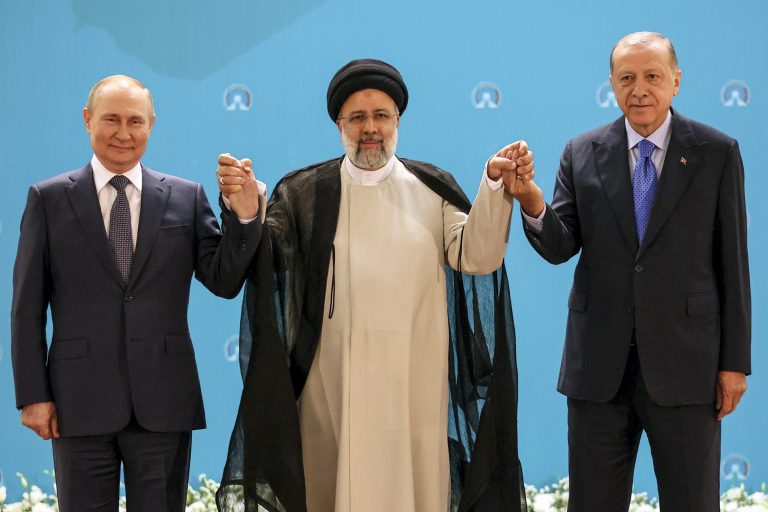
Faced with western sanctions, both Russia and Iran find grounds to showcase military and economic cooperation. Putin’s visit comes one week after Biden’s visit to the Middle East, signaling strong intentions to proceed with the Kremlin’s ambition to establish further influence in the world market despite the strong sanctions. With the continued diplomatic isolation, increased trade with Russia could relieve the Iranian economy under US oil and banking sanctions. Russia also looks to Iran as a potential arms provider avoiding sanctions through bilateral trade routes.
With the war in Ukraine, Iran has not emerged as a more central element in Putin’s diplomacy as both look to establish military partnership. However, the relationship complicates as Russian increasingly cuts into Iran’s share of the oil market. With sanctions severely curtailing Iran’s revenues, oil exports are vital for the country, which is now facing an economic crisis. The inflation rate is above 50%, but Iran has reportedly been forced to slash its oil prices to keep up with Russian discounts.
Iran and Russia are not yet allies, with Russia nearly sabotaging negotiations over the Joint Comprehensive Plan of Action, or Iran nuclear deal, the resolution of which could lead to the relaxation of some sanctions on Iran’s economy. Iran on the other hand refused to condemn the war in Ukraine.
A major part of Iran’s motive to work with Russia is driven by its urgent economic needs and lack of alternatives,” he said. “Iran cannot dismiss its relations with Eastern powers like Russia, as long as there are no options in the West.” (Decent write up but what is the purpose of letting the readers know about the Iran and Russia relationship? We do know that both countries are under sanctions. So what is the implications of Iran and Russian trade in terms of the US dollar for transactions?)
Asian Market Indices – Spill over sentiment from US market
Asian Market closed marginally lower on 19th July as compared to the closing price on 18th July. Shanghai Composite has negligible growth of 0.04% following ShenZhen Composite, and the Hang Seng Index to be down by 0.30% and 0.89% respectively. Nikkei 225 has improved by 0.65%. Following the market opening on 20th July, Shanghai Composite, ShenZhen Composite, Hang Seng Index, and Nikkei 225 have risen by 0.37%, 0.60%, 1.49%, 1.24% respectively.
China to fine ride-hailing giant Didi more than US$1 billion
China is preparing to hand a fine to the long-running probe over data security issues of the tech firm, boosting hope amongst investors that China’s tech crackdown is easing. The fine – imposed over Didi’s cybersecurity practices – would amount to more than 4% of its US$27.3 billion total revenue last year and pave the way for its new share listing in Hong Kong, The Wall Street Journal reported Tuesday (Jul 19).
Didi was prevented from adding new users and its apps were removed from the online stores by Chinese regulators. A rally in Chinese tech firms in Hong Kong rallied on Wednesday as investors were hopeful for the an end of to a 2 year regulatory storm in the sector. E-commerce giant Alibaba soared 4 per cent, while gaming titan Tencent gained 2.5 per cent in early trade.
China’s regulatory crackdown (Don’t repeat. You have already mentioned that.) has eased this year as it grapples with the economic fallout from its zero-COVID strategy, with the country struggling to reach its 5.5% growth target. (If you wish to retain this para, it should be placed at the start of this China reporting. At this juncture, it’s like going to square one.)
However, there is still a strict regulatory environment for tech firms: President Xi Jinping last month called for stronger oversight and better security in the financial tech arena. (So how would you reconcile with the Didi story? It’s an assertion of contradictory trends.)
South-East Asia Market – Negligible Movement
South-East Asia Market Indices such as KLCI and STI have fallen marginally by 0.05% and 0.13% respectively while JKSE has a 1.15% improvement following the closing price on 19th July against 18th July. Upon market opening on 20th July, KLCI and JKSE have shown minor improvement of 0.09% and 0.001% remained flat while STI has improved by 0.56%.
Singapore
A stronger Singapore dollar may be exactly what the country needs to battle inflation, says Barclays
The Singapore market continues to operate above its potential despite labor shortages from the pandemic and strong manufacturing activity (despite strong manufacturing activity?). As the Singapore dollar (SGD) appreciates relative to the policy band set out by MAS as part of its policy tool, it will weigh on the nation’s exports. An appreciation in the currency will slow down manufacture and export demands, while cooling inflationary pressures within the country.
Although it is desired to have strong manufacturing demands, this will also contribute to the country’s inflation pressure especially with its tight labor market driving wages up (???). With the reopening of borders, Singapore has seen more foreign workers coming in with many of them going into the travel and services industry. (Don’t understand the connection of the two sentences in this para.)
Pandemic-induced labor shortage in the country’s manufacturing sectors means there aren’t enough workers to meet the manufacturing demands. Singapore continues to register a trade surplus with the strong demands in the market. (Your thoughts are all over the place. There is no clear line of argument.)
Opinion: Strong SGD will slow down ease inflationary pressure of in the economy, being a good sign for the country.
Foodpanda SG names new MD, anchors regional hub and tech academy
(You should not be reporting. You should have started with “The appointment of Lawrence Wen as the new MD of Foodpanda …) Foodpanda Singapore has appointed Lawrence Wen who will accelerate growth of Foodpanda Singapore’s business through digitalisation. Foodpanda’s new regional headquarters in Singapore houses 1,200 employees from its regional and local operational teams, as well as the company’s global tech hub. The foodpanda PowerUp! Tech Academy will use its parent company Delivery Hero’s global knowledge base in Singapore to power the tech and innovation ecosystem. The tech academy will include programmes and partnerships catered to growing the local tech talent pool, upskilling riders and helping merchants to digitalise their businesses.
Opinion: With an increased effort and commitment to digitalisation and investing into human capital, the online platform will not be able to onboard more merchants boosting competition within the online food space. Coupled with the upskilling of workers, there is good reason for growth as innovation becomes more prevalent amongst workers. (While the idea is there, this is poorly articulated as an analytical remark.)
Boeing , SIA Engineering to shut down Asia-Pac Joint Venture
The joint venture between Boeing Singapore and SIA Engineering, Boeing Asia Pacific Aviation Services Pte Ltd (BAPAS) has been announced to cease through SIA Engineering bourse filing on Tuesday, Jul 19 (This sentence is confusing). The Cessation of operations in August is not expected to have a material impact on SIAEC’s net tangible assets or earnings per share in FY 2022/2023.
BAPAS was incorporated in October 2015 to provide fleet management services for airline operators of the 737, 747, 777 and 787 in the region.
Opinion: With the cessation of BAPAS, it is likely that the airline operations in Singapore will not be looking to spike as this reflects as a cost cutting move by both Boeing Singapore and SIA Engineering (Don’t understand the relationship between the ‘spike’ and ‘cost cutting move.).